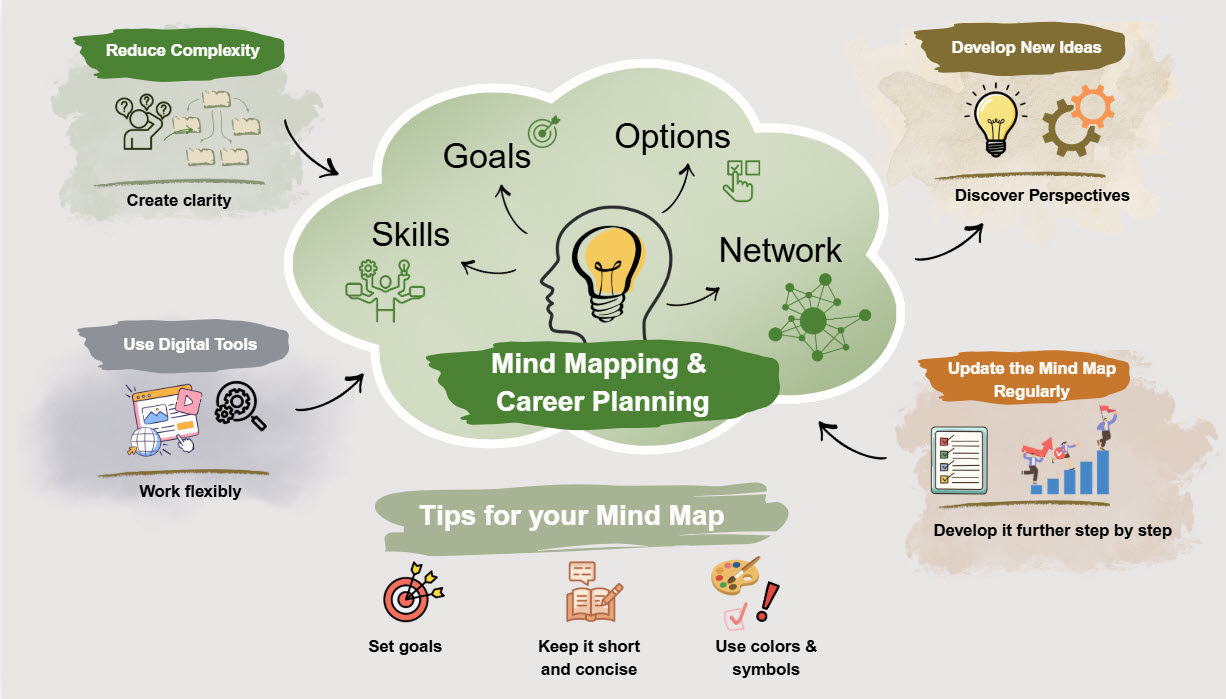
Why mind mapping works in career planning
Mind mapping brings order to mental chaos. It translates thoughts into visual models, makes connections visible, and creates a solid foundation for strategic decisions. Instead of traditional to-do lists, it creates a visual big picture that reveals relationships and opens up new perspectives.
Reducing complexity and creating focus
When thinking about your professional future, many topics often come up at once. It’s about skills, interests, potential job changes, further education, and sometimes even fundamental questions like purpose or personal growth.
Without structure, all of this quickly becomes mixed together. Thoughts jump back and forth, and in the end, what remains is more uncertainty than a clear direction. This is exactly where mind mapping shows its strength.
By capturing your thoughts visually, you automatically bring them into a certain order. You start to recognize connections that you may not have been aware of before. Things that still seem vague in your mind suddenly take on a clear shape.
With a mind map, these factors can be visually clustered. You can see at a glance:
- Where your current competencies stand
- Which skills you are still missing
- What options arise from them
This allows you to quickly recognize where you currently stand and what truly matters to you. At the same time, it becomes clear which steps are realistic and which may still take some time.
Developing new ideas instead of just planning
A major advantage of mind mapping is that it not only structures your thoughts but also inspires you. As you build and connect your ideas, new ones emerge automatically. You might realize that you have skills that could be applied in a completely different field. Or you may discover that a goal you had in mind doesn’t actually suit you that well.
This process often happens naturally. You’re not actively trying to be creative—instead, new perspectives develop as you organize your thoughts. That’s exactly what makes mind mapping so valuable for career planning. It doesn’t just take you from A to B, it also reveals paths you hadn’t even considered before.
Mind mapping opens up new perspectives in career planning:
> Career changes into new fields become visible
> Hidden potential comes to light
> Alternative career paths emerge
The right tools & techniques for your mind mapping
Digital tools that make your daily life easier
Mind mapping works in a very classic way with pen and paper. It even has its own charm because it’s direct and uncomplicated. At the same time, digital solutions today offer many advantages—especially if you want to continuously develop your thoughts.
Tools like XMind, MindMeister, or Miro are great examples if you prefer working digitally. They help you design your mind maps flexibly and adjust them at any time.
The big advantage is that you don’t have to start from scratch when something changes. You can move, add, or restructure content without your entire plan becoming confusing. Especially in career planning, which often evolves step by step, this is a real benefit.
In addition, you can access your mind maps anytime—whether you’re in the office or on the go. This way, your ideas don’t get lost and you stay consistently focused on your goals.
Best practices for effective mind mapping
For mind mapping to truly benefit you, it’s less about the tool and more about how you use it.
1. Start with a clear end goal
There is always a central theme at the beginning. This can be a specific goal or an open question that is currently on your mind. From there, you develop your thoughts step by step.
2. Work in dimensions
It helps to think in different areas. For example, you can consider which skills you already have and which ones you still want to develop. At the same time, you can look at which experiences have shaped you and the direction in which you want to grow.
3. Use keywords instead of full sentences
It’s important to keep your thoughts as simple as possible. Short terms or keywords are completely sufficient. This keeps your mind map clear and helps you quickly see what really matters.
4. Use visual anchors
Visual anchors are what make your mind map truly engaging and easy to understand. It’s not just about making it look nice—it’s mainly about processing and organizing information more quickly. Your brain works strongly with visuals, which is why colors, shapes, and symbols help you instantly recognize what matters.
For example, you can use colors deliberately to separate different topic areas. Everything related to your skills could have one color, while goals or next steps use another. This way, you can quickly find your way around, even after some time.
Icons or small symbols can provide additional support. A checkmark can represent completed steps, an exclamation mark can highlight important points, and a star can mark long-term goals. These small visual cues make it easier to identify priorities at a glance—without having to read every single point.
Colors, shapes, and symbols help you understand your mind map more quickly and structure it more effectively. Different colors clearly separate topics from one another, while icons highlight important points. This allows you to see at a glance what has priority and maintain an overview—even when dealing with a lot of information.
5. Review your mind map regularly
Over time, your mind map will grow and evolve. New ideas will emerge, while others lose their importance. That’s exactly the point. Your career is constantly developing, and your mind map supports this process. It’s not a fixed plan, but rather a tool that helps you realign yourself again and again.
Mind mapping is not a miracle solution, but it is an incredibly practical tool when it comes to creating clarity. It helps you organize your thoughts, develop new ideas, and shape your own path more consciously.
Especially in a working world that is constantly changing, it’s important not to just go with the flow. Those who regularly take the time to reflect on their own goals and make them visible make better decisions and remain more satisfied in the long term.
Mind mapping can support you exactly in this. It’s easy to implement, flexible to adapt, and adjusts to your pace. And sometimes, a single well-structured mind map is enough to see your next step much more clearly.